The narrative of “All Too Well” is well documented, from its painful beginnings to Taylor Swift’s triumphant return to it with a whopping 10-minute version. One thing you may not know about its history? Who convinced her that the song had legs even beyond the Red Tour.
Meet music writer Rob Sheffield, who has covered Swift’s career from the beginning. If you’re reading this, you’re presumably a Swiftie — which means you’ve likely at some point come across Sheffield’s piece for Rolling Stone ranking every single song Swift has ever put out. (As of now, the list is up to 274 songs — more than double the size than when he originally wrote the list after the release of 1989.)
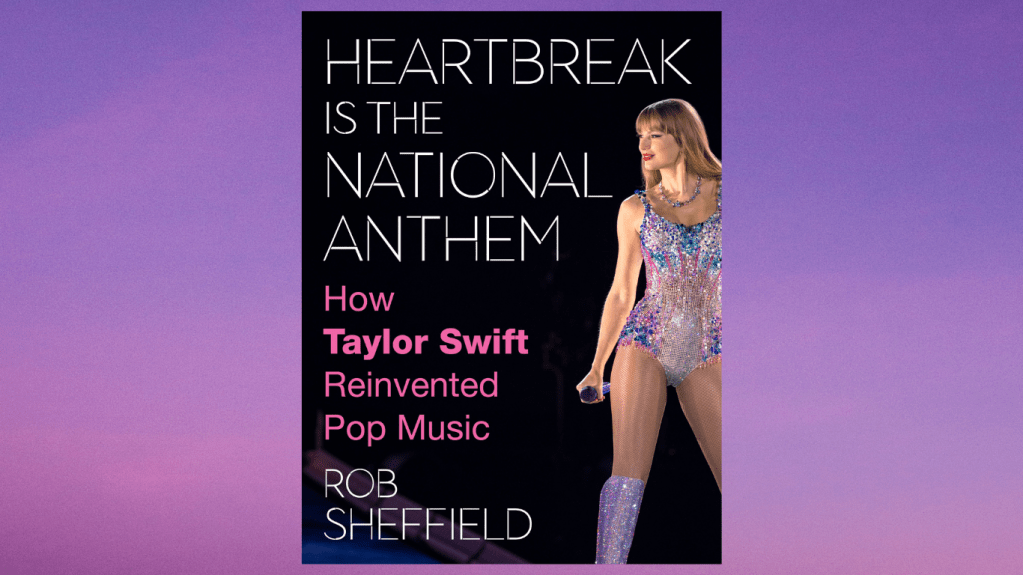
As he writes in his new book, Heartbreak Is the National Anthem: How Taylor Swift Reinvented Pop Music, a conversation with Swift backstage before the opening night of her Reputation Tour revealed that the singer was one of that article’s many readers.

“[Swift] warned me backstage she had a surprise,” Sheffield writes. “‘I added All Too Well to the set because of you,’ she said. ‘It’s number one on your list. You changed my mind about that song. You convinced me it was more than just a Red Tour song.’ My trusty poker face must have failed me, because she looked concerned and asked, ‘Is it okay I told you this?’”
(A missed opportunity for her to say “Is it cool that I said all that?” if you ask us.)
Related reading: How do you write a book about Taylor Swift when she can’t stop writing songs?
“All Too Well” wound up being an acoustic surprise song for night one (“It was rare, I was there,” Sheffield writes.) But learning that this song was “more than just a Red Tour song” paved the way for the major success of Red (Taylor’s Version) and the 10-minute version’s permanent place on the Eras Tour setlist.
“It’s something about the kind of artist she is: that she could even write a song like ‘All Too Well’ and then go years without singing it,” Sheffield tells Taypedia. “It’s kind of mindblowing that she toured for years not doing that song at all. … She’s an artist who responds to how people hear her music.”
The book features Sheffield’s observations and analysis as a reporter who’s been covering Swift from the start. (He writes: “Taylor and I have crossed paths a few times over the years… But I know her much better as a songwriter than I ever could as a person, and have an infinitely deeper connection with her music.”) It doesn’t include any new interviews with Swift, but Sheffield says her team “knew about [the book] from the beginning.” Rather, he focuses on dissecting what exactly makes Swift’s career so revolutionary and so unparalleled.
“I wanted to write something about Taylor that wasn’t about her celebrity, wasn’t about fame, wasn’t about fashion, wasn’t about image,” Sheffield says. “It was about the weirdest thing about her, which is that she is the one who writes these songs. That’s where her place in history is. That’s what puts her up there with the all-time greats, like [David] Bowie and Prince and [Bruce] Springsteen and Stevie Wonder and The Beatles.”
Swift is a writer who is uniquely skilled in being able to look back on an experience that just happened with the wisdom of a much older version of herself, Sheffield posits in the book. “All Too Well” — and let’s not forget “All Too Well (10 Minute Version) (Taylor’s Version)” — is perhaps the best example of that, which is why it’s both the “central song in the book” and the “central song in [Swift’s] whole story.”
“She had this great song, but it was too painful for her — she didn’t want to sing it,” Sheffield says. “It was a story she didn’t want to go back to, except people just wouldn’t stop making her talk about it. … So she went back and opened up the story that she thought was closed, and expanded the song. I love how that sums up her whole approach to songwriting: that she’s seeing her life as this ongoing story that you’re constantly looking back on and revising.”
Swift is “truly a geek’s geek” when it comes to music, Sheffield notes. He points out how groundbreaking it was, when Swift began as a curly-headed teenager armed with her acoustic guitar, for her to be the mastermind behind her songwriting. It was an anomaly then. But she has since paved the way for a generation of young female artists (Sabrina Carpenter, Billie Eilish, Olivia Rodrigo, Chappell Roan and Gracie Abrams, to name a few) to feel there was a place in this world for them to voice their own feelings through music.
“It didn’t really happen in country at the time… but now in 2024, that’s just what music is,” Sheffield says. “It’s all of these artists who have taken their inspiration from the kind of singer-songwriter that Taylor invited them to be. It’s a really strange case where we now live in an entire world of Taylor Swifts. And these artists are all very different from each other, and they’re all very different from Taylor, but they’re all taking one piece of what she invented and running with it in their own direction.”
As the Eras Tour is winding down — shows in Toronto kick off this weekend before the tour ends after nearly two years on Dec. 8 in Vancouver — Swifties have begun speculating about what’s next for the ever-busy artist. Sheffield hypothesizes that she’ll “jump right back into music-making” given Swift’s “restless musical imagination,” but caveats that his guess is as good as yours.
“I’ve been writing about Taylor Swift for so long — her entire career — and I’ve constantly been trying to guess her next move, and I’m always guessing wrong.” he says. “I should know better by now there’s no point trying to predict her next move, yet I can’t help it. … Who knows? Not me. And yet something about her makes us want to keep guessing, even though we know that she’s going to play us for a fool.”
Buy Heartbreak Is the National Anthem: How Taylor Swift Reinvented Pop Music
 Taypedia