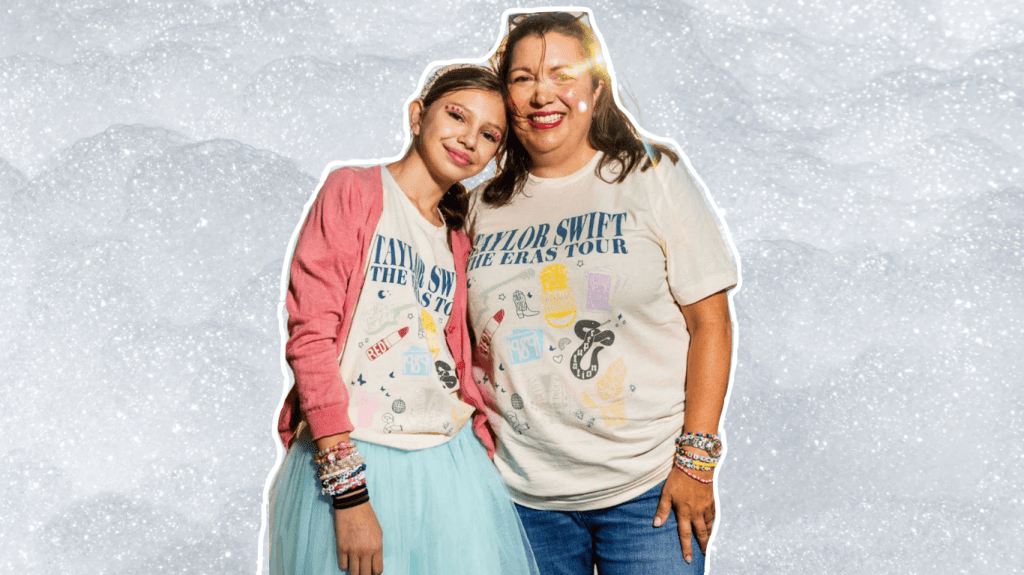
It’s been 17 years since my 6-year-old daughter came home from elementary school and said, “Mommy, you have to listen to this singer—I really like her!” The singer in question? A teenage Taylor Swift. Swift was new on the music scene, and some of us (it’s me, hi) were convinced Taylor was going to be a passing childhood fad, like Barbies and Disney Princesses. Instead, we now find ourselves singing and dancing along to Taylor with GenZ (and younger) Swifties. How did this happen to the slightly cynical MTV generation raised on the likes of Madonna, Cyndi Lauper, the Ramones, and glam rockers, among other genres?
A 2023 study of Swift fans found that 21% of us are GenX (23% are Baby Boomers), and though I cringe at the term, we are known as “Senior Swifties.” So what’s so appealing about Taylor Swift for us GenXers? I interviewed some academics and other GenX Swift fans to find out.
Dr. Michele Ramsey, of Penn State University, is a fairly recent convert to Swift-dom. This fall she’ll teach a brand-new class titled “Taylor Swift, Gender, and Communication.” Introduced to Swift by her 9-year-old “bonus niece” (and her millennial mom) she enjoyed the music, but on hearing “All Too Well” she “realized that my niece knew the meaning of the word patriarchy”. That’s probably, in part, because her mother is a faculty member, but she still knows a word and what it means at nine that I didn’t know until I was in college. I think and hope that Taylor Swift is helping rear a generation to be comfortable showing vulnerability and kindness, but also saying NO to oppression and discrimination.”
Ramsey adds, “I think what’s phenomenal about Taylor Swift right now is that she is the center of the pop culture universe and that she’s also just plain central to the world right now, even outside of pop culture. And I think she’s accomplished this through lots of hard work, but I also think that this is the first time women’s stories have been central to popular culture and that’s because of Taylor Swift.”
Swift tells the stories of our lives with music and poetry, winning over multiple generations. GenX, as the generation who arguably came of age in the post-feminist movement and during a time when female musical artists like Madonna, Cyndi Lauper, Annie Lennox and Kate Bush were able to sing about women’s experiences in a way previous generations had not. That led to the 90s rise of influential singers like Alanis Morrissette, Tori Amos, and Sinead O’Connor, who further pushed musical and lyrical boundaries. Swift picked up that torch and carried it further as she dissects feminism, patriarchy, love and girlhood in her own way.
As an older Swiftie, nearing my 50th birthday, I find that her music encompasses so many life trials, love, questioning love, all the nuance of life. Her music speaks to people who have lived, maybe sometimes not so easily.
I enjoyed listening to Taylor when my daughter played one of her albums, but I didn’t really become a true Swiftie until she played “Ronan” for me. I’m a mom who lost a son too, and this one broke my heart and made me sob. Taylor was 23 when she wrote “Ronan”, and I can’t fathom how anyone that young could have understood so completely, and written so beautifully about, the pain of such a loss. And she carries on doing it, with songs like “Bigger Than the Whole Sky,” which have resonated so deeply with women grieving miscarriages, and “This is Me Trying,” with individuals struggling withmental health issues.
Ashleigh Jāë echoes my love of Swift’s songwriting. “The song I relate to the most is probably ‘This Is Me Trying’—was it written especially for me? Her lyrics are poetic genius and speak directly to the heart of a situation while exploring and exploiting the commonalities of the human condition. I think this is why she appeals to such a large spectrum of people on such a personal level.” Jāë first identified with Swift thanks to the lyrics of “Tim McGraw,” looking in the “bittersweet rear-view mirror” of a life that was as she and her family moved from post-Hurricane Katrin New Orleans to Seattle to start again.
Dr. Catherine Fairfield taught a course titled “Speak Now: Gender & Storytelling in Taylor Swift’s Eras,” at Northeastern University this past winter. Part of her intergenerational appeal, says Fairfield, is because, “Taylor has explored the theme of girlhood both when she was writing as an adolescent and while she writes as an adult looking back on the experience of girlhood.”
Fairfield’s course examined the traditional ways women have told stories throughout history, via fairy tales, gossip, and personal confessionals, and how literature has influenced Taylor’s writing, which references works from, among many, The Great Gatsby, Peter Pan, the poetry of Robert Frost and the plays of Shakespeare.
Says Fairfield, “Taking the song ‘Fifteen’ as an example, the descriptions of friendship and heartbreak give points of connection for young people to latch onto relatable experiences while also offering reflective insight into growing up through those experiences and looking back on lessons learned in a way that draws in older listeners, like moms. The voice in ‘Fifteen’ even moves between past, present, and future tense while looking at those high school moments from different standpoints. With this in mind, by offering several entry points into her narratives for people at different stages in their own lives, Taylor’s music makes space for parents and children to share enjoyment and emotional catharsis together.”
Those literary references and poetic lyrics are a big appeal for GenX fans, including former English majors like me and Katie Merithew. Merithew saw Swift at a festival in Baton Rouge around 2010, and was struck by how young she was, and, like me, thought Swift would fizzle out. It wasn’t until 2023 that she identified herself as a Swiftie. “I had joined TikTok and people were discussing her lyrics like they would literature. I was an English major, so I crave discussions of literature and words. That’s like fuel for my soul.” She adds that the albums folklore and evermore started “giving me back my life” after a significant personal loss. During the pandemic, Merithew, who works in a neonatal ICU, identified strongly with “epiphany.” “When I heard epiphany and the relation of working in healthcare to being on an actual battlefield, it really hit me. People say we were on the front lines and it was like a battle—something about how she tied it together was so perfect.”
Swift sings about relationships in a relatable way too. Danielle Black has the “All Too Well” 10-minute version memorized (“like most Swifties” she says). “I can scream sing it like the best of them! It resonates with me because I had that one awful ‘Jake G’ relationship that broke my spirit.” Black adds, “she’s a storyteller through her music I feel like she’s only one of a few musicians in history that have that true gift of originality in songwriting.”
For Tracy Baker, “As an older Swiftie, nearing my 50th birthday, I find that her music encompasses so many life trials, love, questioning love, all the nuance of life. Her music speaks to people who have lived, maybe sometimes not so easily. I found her at a time of great reflection and clinical depression. Her words spoke in a way that made my soul awaken to wanting a very different life. Her words heal us.”
Adds Ramsey, one of the things that makes Swift appealing is that “she’s a woman not asking for permission to do what she wants to do.” Early on, she led her career the way “The Man” told her to (we’re looking at you, Scooter Braun) until she decided she was done. That’s a universal struggle women can easily identify with. For fan Thania Sanchez, those themes ring true. “I think Taylor plays with a lot of feelings that are very universal in general, but for me she explores a range of experiences that as a woman makes me feel very seen. For example, having other people take credit for your work or diminish your accomplishments is something that so many women experience and she sings about. I was a professor at Yale, and the amount of times a man repeated the same thing I had just said and gotten nods or compliments when I got no response was frustrating. I sat there thinking ‘I literally just said that’ and only other women in the room would notice and we’d share this look.”
From love being lost to being considered a ‘mad woman,’ this album just felt like me in a way I couldn’t put into words. My soul connected with folklore, and I could not stop the snowball that was rolling me downhill to becoming a Swiftie.
Other GenX fans echo those sentiments. For Tracey Baker, who embraced Swift after watching Miss Americana during the pandemic. It was when she listened to folklore (and watched the Long Pond Studio Sessions) that she “felt like my life, hopes and dreams [were] all in one album. From love being lost to being considered a ‘mad woman,’ this album just felt like me in a way I couldn’t put into words. My soul connected with folklore, and I could not stop the snowball that was rolling me downhill to becoming a Swiftie.”
Keri Messerich of Texas didn’t consider herself a fan until her husband introduced her through the Eras movie. Listening to folklore after that “was cathartic and healing. I think she has an old soul. She just speaks through her songs. She also makes her fans feel like we are the only one. Did I ever think I would eat, drink, and sleep a musical artist!? Nope.”
“She’s a strong role model,” affirms Robin Brook Lears. Reputation stands out for her: “I think Taylor really found her voice as a strong woman standing up for herself during this period. Unfortunately, due to all the circumstances that she encountered; she didn’t really have a choice but to stand up for herself. I think that’s the takeaway for me and for my kids. That’s where she really comes to be a strong role model, even for those of us who are older than her we can still identify with so many of her messages. You don’t have to be older than someone to be an example.”
Swift’s gifts as a storyteller, songwriter, and businesswoman have given people everywhere a new way of thinking about female power, changing the zeitgeist of the 2000s and beyond. Says Dr. Ramsey, “I can’t think of a time in women’s history that women’s stories have been the center of pop culture or general culture. Having a woman doing all of those things and telling stories women can relate to everywhere is groundbreaking.”
*Header photo credit: AARP
 Taypedia