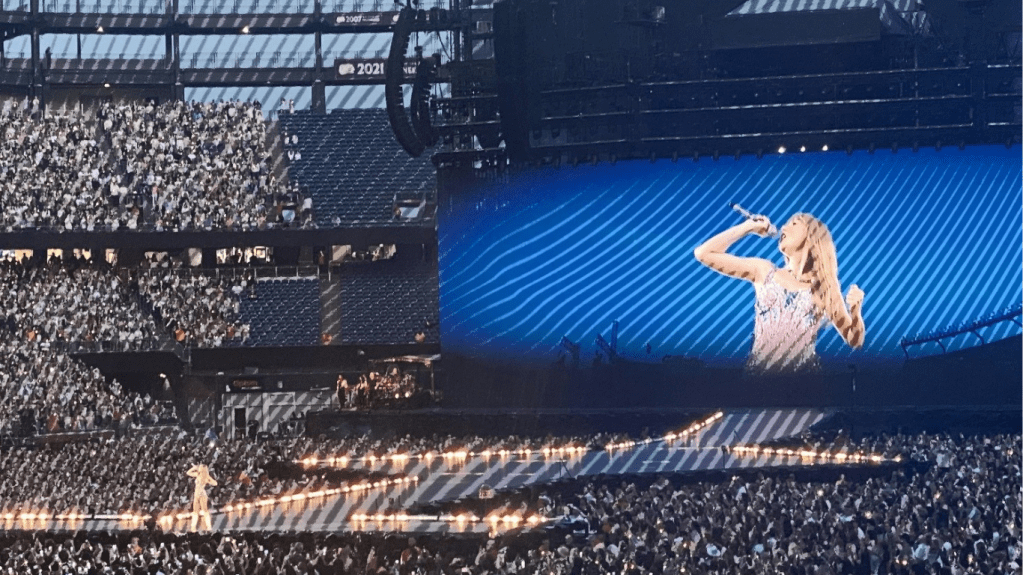
Very few artists could ever hope to change the face of music quite like Taylor Swift has. The Eras Tour, concluding its Europe leg in late August and heading into its final leg in October, is a prime example of this. What other artist could get away with a celebration of their career mid-career?
The Eras Tour was the mastermind herself making the most of the unique opportunity she found herself in: with three albums she couldn’t tour due to an unprecedented pandemic, six albums being rereleased in an ongoing battle for artist’s rights to their master recordings, and her tenth album being one that looks back on her life. It was a perfect storm for an over three hour concert that will tour nearly two years with intense visuals, a giant LED stage, a series of costume changes (and combos), and an album launch somewhere along the line as a little treat. It’s a hard act to follow or even keep up with as Swift continues to break all the molds the music industry had laid down for her.
Table of contents
The cultural phenomenon of Swift
It’s not that others have not tried to better understand the artist and phenomenon known as Swift. Many have tried, focusing in on one aspect of the big picture because to try and consider the whole would be outright impossible. There’s the economic aspect of her Eras Tour. According to The Washington Post, the US will receive a $5.7 billion dollar economic boom with the other countries fortunate enough to host the tour receiving similar benefits. And Forbes reported that Swift herself became a billionaire during this tour and holds the distinguished honor of achieving such through music alone.
There’s also the legal considerations. Did the rise of (Taylor’s Version) force record labels to change their standard contract language to prevent an artist reclaiming their work when the master recordings are sold to another? It seems so. Recent reports say that new contracts in the music industry are including clauses to prevent artists from rerecording songs for 30 years in some cases, a drastic deviation from decades-long norms that seemingly could only be caused by the success of Swift’s rerecords.
And of course, there’s the song analysis, which I’ve lately seen even libraries get in on (much to everyone’s joy). Swift has a particular talent for lyricism, and in said lyrics, she references other songs and the classics so often overlooked outside of a classroom.
Third places (Taylor’s Version)
But I would argue–and in this article I want to–that Taylor Swift and the Swifties are changing the game in other ways as well. Or rather, Taylor Swift might have created the perfect storm for us to revisit an old sociological concept and examine what ways in which it has been forced to adapt in a shifting cultural landscape. Considering Swift has ascended to a height in which she is sparring with the giants, there were inevitably going to be some earthquakes in her wake. And not even sociology was fully spared from them.
Considering Swift has ascended to a height in which she is sparring with the giants, there were inevitably going to be some earthquakes in her wake. And not even sociology was fully spared from them.
Okay, admittedly, I’m not proposing a cultural shift done by Taylor Swift single-handedly. Rather, it’s one created by the fan community that has risen around her career, a community revitalized by this recent tour to the point that it too has likely broken molds and records. Those just aren’t as well kept as the titles Swift is left to pursue after sweeping so many other awards and victories.
As far as fan communities go, the Swifties are one of the largest, most visible, and most active. In recent months, we saw them appear in parking lots around stadiums, dancing in movie theaters, and gathered around grainy live streams of the concert every single night Taylor Swift is performing. But even on nights when Swift is not performing, they still have some sense of community. They come together to pick apart songs or potential Easter Eggs, sharing ideas and debating amongst themselves. They rank their favorite albums sometimes with highly advanced spreadsheets that they pass amongst each other and share other hacks to find dupes (or more affordable copies) of Swift’s latest outfits. Regardless of whether or not Swift is active on stage or guest appearing on a television show, the Swifties have carved out and maintained a place on the internet for them to gather. Or places, depending on how you want to count it. Either way, in our largely digital world, many of us–Swifties or not–would confidently say that there are segments of the internet where Swifties gather despite not knowing each other in other contexts or being separated by geography and other factors.
When put that way, it sounds distinctly utopian, almost. This is a place accessible to all where all are welcome, but while Thomas Moore’s conceptualization of an ideal society is interesting and glamorous–not unlike Taylor Swift, funnily enough–there is an entire world of literature to consider beyond that one book. In this case, I would like to consider a concept in sociology called “the third place.”
What makes a third place?
Coined by Ray Oldenburg in his 1989 (ha) book The Great Good Place, the third place represents the social surroundings outside of the other two places, home (first) and work (second). The appeal, purpose, and need for the first two places is relatively obvious, but the third place represents a more neutral, laid back social environment that community members can utilize as they please. Think of it as the anchoring point for a community. People can go out and hang out together in something like a park or a library. These are spaces no one person or small group of people have an recognizable claim of ownership to. People just exist in these spaces, and they have a good time doing so.
Private businesses such as coffee shops and movie theaters meet the definition of a “third place” as well. Despite being businesses with owners who can instill rules at their whims, they are businesses that don’t innately filter out their patrons or guests, they work best when they have the broadest, more welcoming appeal, and they are venues of primarily lighthearted engagement and merriment. These are some of what makes a third place.
But to get deeper into the weeds of it, Oldenburg identified eight main characteristics for what makes a “third place,” and while I will dissect these later and explain how the Swifties as a community meet those metrics, for now, I present them here without much discussion to help you understand this more amorphous concept. The traits are:
- Neutral Ground: Occupants have no obligation to be there. Unlike the first two places, they lack any binding ties and can come and go as they please.
- A Level Ground: One’s societal status is irrelevant.
- The Main Activity is Conversation: While there can be other things to do in a third place, people are often chatting amongst themselves. These are light-hearted and playful discussions not unlike what you would see between friends.
- Accessibility: Spaces must be open and accessible to those who wish to come in. So no doors with passwords or other means of filtering those who come in. And all occupants need to be able to exist in that space without unreasonable burdens.
- The Regulars: The regulars are those who are always there maintaining the tone, culture, and history of a space while also attracting and welcoming newcomers.
- A Low Profile: These places have a mgtore wholesome vibes than extravagant or grandiose vibes. Everyone should be welcome no matter what walk of life you come from.
- The Mood is Playful: Conversations in third places aren’t tense or marked by hostility. They should be playful. Witty and humor is valued above all.
- A Home Away From Home: This is where the status as a community “anchor” comes in. Occupants of third places should have the same feelings of warmth and belonging that they associate with home. With that comes a sense of rejuvenation from spending time there.
I wanted to lay these traits out for you largely out of fear that you, dear reader, don’t have the best frame of reference for what a true third place is.
It is a new facet of our culture that both falls into familiar patterns and reimagines those patterns. Failure to properly consider these developments–for whatever reason you might have–is only furthering the gap between theory and practice to all of our detriment. We only stand to benefit when we understand our world and society as it is and not as some people might wish it would be.
The decline of the third place
The only real problem with third places is that they are on a steady decline. Or that has been the fear for at least the past decade, if not more. And it is very possible that you–depending on how old you are–may not know the same sort of third place that Oldenburg defined in his book largely because you do not have access to one.
The decline of third places has been attributed to various factors. The easiest way to understand it is to parse out the specific factors working against the various types. Churches and other religious houses are considered third spaces, but as Gallup polls show, attendance at religious services is declining. Libraries, another example of a third place that Oldenburg didn’t include in his list likely as an extension of his cultural norms, are struggling to keep much needed funding, according to the American Library Association. And those of us who are old enough to remember what it was like to go to the mall also know how empty those once bustling hubs now are. Coffee shops are more stops along our morning commute than they are places of social interaction. And when is the last time you saw a video of some stranger harassing a group of people just enjoying a park? I’m willing to bet it was somewhat recently. It is for me.
On the whole, Oldenburg theorized in his book that Americans were showing an increased preference for private lifestyles, solitary activities, and other more individualistic mindsets since the end of the second World War. Add to that, the demands of our workplaces were also growing. With the first two places claiming all of our attention, there was little left for us to give to a third place. And, of course, the rise of COVID-19 hastened this process along. Our confinement to the first place–or first and second place depending on one’s profession–fueled this decline as we pulled away from these spaces in the name of public health. The world then adapted, and our sense of normal has been irrevocably changed. It was necessary, undoubtedly. But if something is inevitable so are the consequences.
These consequences are the point at which I think we should be concerned. I’m not the sort of person to clutch my pearls because the world around me is changing. The world needs to change in order to grow and for systems to be improved upon, and there are–undoubtedly–flaws with the way things were that we need to overcome. Don’t get me wrong; we still need libraries, and we shouldn’t be cooped up in our homes any longer than necessary. That’s a great way to go completely stir crazy. And outdoor spaces like parks provide numerous health benefits…
Admittedly, I have some skepticism surrounding the loss of third places. But regardless of my opinions on the matter, there are real downsides to these losses. Given that these are social spaces and outlets for us to connect to other people, even in the absence of a formal study on the issues, I am fairly certain that this shift fuels the ongoing rise in loneliness that a psychology study out of Ruhr-Universität Bochum identified. Young adults are feeling more discontented and isolated than past generations did at their age. This study likely supports some of your own observations or maybe even your feelings.
The link isn’t obvious, but the decline of third places means a decline of community. Third places are the venues that provide that social stimulation required by our very nature. Human beings aren’t meant to be completely alone, though each person has their own way of finding that social gratification.
Though our psychology needs are incredibly important, the loss of community or social connection comes with other losses as well. In communities–particularly in third places–we can catch glimpses into the inner worlds of those around us as well as present our own to a willing audience. Through dialogue, third places are venues for self-expression, on one hand, but they are also a space for people to come together and vent about frustrations, challenges, and other issues in their lives. Conversation is a key part of connection.
Conversation can be a part of any of the three places. But in third places, conversations take on a different form because it is only in this third place that we connect with those outside of our bubbles. Our homes are full of familiar people who likely share a cultural heritage and story with us. The worldview attached to a second place or a workplace is a bit wider, but coworkers are still working towards one common goal. And the company’s culture is dictated from someone at the top. There is a pressure or need to adhere to those norms that make them binding and homogenize the office. On the other hand, strangers come together in third places. It’s a safe and low stress environment for them to do so. There is no expectation or standard to meet or exceed at. And an escape from a bad conversation is available to you at any time. Consequently, in a third place, we are able to safely and properly enter a dialogue with those we had no way of interacting with otherwise. In the course of that conversation, we could come to understand them and their world view. We may reject it or incorporate that worldview into our own. But the choice is ours to make.
This expansion of our world can bring multiple things to our proverbial table. It teaches us compassion and empathy through a direct and lasting reminder of the enduring nature of a person’s humanity and need for dignity. We learn about the broader world in a very ground, demonstrable sense–with one person as the anchor or example. Through these exercises, we also come to accept, more passively, that we are part of a broader world. We are a piece of a larger machine, and though the lesson is not explicit, we come to realize that we matter. It’s a feeling stoke in us when we are heard and acknowledged by those around us, when we are ‘seen’ by other members of that third place, even when such sightings are just in passing.
This is a key part of self-actualization, defined most broadly as an individual reaching their full potential and maximizing their talents and abilities. This could be understood as someone being able to practice fulfilling hobbies while having a career they enjoy and are good at, a family that meets their definition, and a role in their community. The latter often includes some sense of civic engagement or active work in improving one’s community, though “role” itself is another term that has to be defined by the individual.
Self-actualization is a need in and of itself. Much like human beings need social interaction to maintain a feeling of contentment if not outright sanity, we need to feel like we are growing or actually grow in order to really be content with our lives. To stay stagnant would be to fall into boredom, and boredom (the deprivation of excitement or stimulation) isn’t entirely unlike hunger or thirst (the deprivation of food and water, respectively). Those latter states drive us to act in ways we are conscious of. In hunger, we seek food, and in thirst, we seek some sort of beverage. The desire to avoid boredom is a bit less obvious, but we see it when we pick up our phones to scroll an app or play a mobile game. And I genuinely ask what that gets for us as the individuals picking up the phone. It is a question I pose with the utmost sincerity, particularly in light of more engaging alternatives that give us a better hit of the relief we seem to be after. If we are not content with just doom scrolling, why shouldn’t we actively pursue something else.
Even if third places completely fall away–a real possibility that I personally dread–the deep seated needs that they once satisfied remain in us. That aspect of this equation has not and cannot change. So are these being completely neglected or have we found some sort of outlet for them?
Fandom as a third place
In this context, I can’t make any sweeping generalizations, but the Swifties can make their own third place, one that is predominantly digital with real world manifestations–i.e., The Eras Tour stadium, the outdoor areas outside of The Eras Tour, museum exhibits, fan-organized events, etc.
When it comes to social media and the decline of third places. Many argue that social media contributed to this decline, classifying it as one of those pursuits that keeps us predominantly indoors and alone. But social media sites incorporate socialization as part of the website’s design. What started off as a means of connecting with people who knew in the real world has expanded to a domain for making new connections. This has been caused, in part, by the platforms’ need to keep users engaged for longer periods of time to maximize the potential revenue generated by each user either through active time or in data that can be sold.
Regardless of corporate intentions, the Swifties and other communities have carved out a place for themselves through their love of and devotion to Taylor Swift and her music. They have made these virtual gathering places for themselves and their peers in a way that I think either is the next iteration of the third place or is at least analogous enough to be significant.
In this current media age, these online places can be a bit harder to recognize. Unlike the forums of bygone internet days, divisions from one themed online community to another aren’t so readily apparent. It is easy, perhaps overly so, to fall from one online community to another thanks to the algorithms that serve as a figurative concierge to users, one that doesn’t take direct input or guidance from the customer. It can, however, deliberately be overruled with a direct search and these more direct means of seeking out these venues will eventually translate into feedback that could shape the algorithm.
Regardless, Oldenburg and others would likely balk at the lack of physicality. While it wasn’t an intrinsic characteristic of third places, it was somewhat implied or built into the understanding. Maybe that is simply a product of the times, of a sociologist who could not have foreseen what culture would look like over thirty years later. Or maybe this was a sincere, genuine belief that no technological development could have challenged. I cannot say. Oldenburg did, however, leave us those aforementioned eight characteristics, and I would argue that the Swifties clear those hurdles rather well. Notably, there are small subsets of the community that can provide exceptions to each of these traits or rules, but I am speaking about how the community is on the whole.
- Neutral Ground: Regarding the lack of obligation, online communities might have some internal norms that will lead one to maintain their presence, but it’s not a binding agreement. Swifties can come and go or be as engaged in the fan community and fan projects as they wish. There is no admissions test or fee.
- A Level Ground: Regarding one’s societal status or class, Swifties come together from all walks of life. Yes, variant collecting can get pricey. As someone who collects physical media, I know this all too well. But streaming from ad-based services is just as valid of a way to enjoy Swift’s music as physically purchasing media. And many Swifties buy her merchandise, many craft with her lyrics in mind, but there are far more who don’t.
- The Main Activity is Conversation: Regarding discussions, Swiftie content is largely discussion-based. Whether its song analysis, album theories, gushing about The Eras Tour outfits, etc, etc, there is always some piece of news to discuss or some old interview clip to share anew. Social media is largely a venue for ideas. It is a space to express one’s thoughts and provide commentary on others. This expression can be in text or in video, in essay or in skit, but either way, it’s all conversation.
- Accessibility: Regarding open and accessible spaces, while internet access is not completely guaranteed, the community is still fairly open and available without clear barriers.
- The Regulars: Regarding those who are always there maintaining the space, there are some Swiftie creators more visible than others, some fan accounts that are clearly marketed as fan accounts, and–of course–Taylor Nation and their light jabs at our fan theories.
- A Low Profile: Regarding a more wholesome and less extravagant atmosphere, there are a few factors at play that keep this community grounded. For one, Taylor Swift doesn’t promote designer or luxury goods like others celebrities do. On the other hand, the relatability of Taylor Swift’s lyrics helps to keep this community grounded in the real world and not in the fantasy of wealth that other influencers sell their fans.
- The Mood is Playful: Regarding playful conversations, there are some niches in this fan community that stand as notable and infamous exceptions to this, but on the whole, fandom is defined by enjoying something unabashedly. The Swifties aren’t an exception to that.
- A Home Away From Home: As I said earlier, occupants of third places should have the same feelings of warmth and belonging that they associate with home. Other scholars suggest that a true third place must offer relief from the stresses of everyday life in the same way a home offers a retreat from the pressures of the outside world. I would argue that we do see here. However, it’s not the Swifties that have created this for themselves, per say. Music, in general, is an activity that can soothe anxiety or relieve stress. We might see distractions or some sort of reprieve in the humor of Swift sketches. But as a final note, it’s Swift’s lyricism that grounds her audience. Her words are something fans connect and respond to. She is able to give them the means of expressing their hurts and heartbreaks in all their complicated and nuanced ways. That does make Swifties feel seen, but as an extension to feeling seen and recognized, they can feel a sense of acceptance and belonging in that place as well.
As for the benefits of third places, I do think the Swifties are getting them. Granted, each Swiftie is getting a different dosage depending on their own engagement in the fan community, but it’s not a charge you couldn’t make of a traditional third place. Each community member can dictate their input and receive their corresponding output. Some of these benefits are hard to codify, but when it comes to “civic engagement,” showing up for your community and larger world, we see that in a variety of ways.
There is the more overt political activism. An account entitled “Swifties for Harris” has popped up on my FYP a time or two. Swift’s song “You Need to Calm Down” from her seventh studio album Lover (2019) has become an anthem for LGBTQ+ rights both in Swift’s intention and in the way the fan community has used the song. On the other hand, there’s the more political neutral displays of support. For example, Swifties are known for making waves of $13 dollar donations to animal shelters, Jason Kelce’s BePhilly Foundation or to a fellow Swiftie’s family when a car accident took him from this world too soon. Thirteen is famously Swift’s lucky number and has turned into a way the community can signal to one another that they are working in tandem for the same goal.
These donations also suggest that Swifties have a strong sense of compassion and empathy, the same sort of thing that is nurtured by third places but hard to prove or quantify. These are acts of giving, however, even when a Swiftie is not directly touched by a recipient.
And it is worth noting that these are not actions that Swift herself has pushed or promoted. She often models charitable behavior by making donations of her own and giving hefty bonuses to her staff, but she does not insist that fandom to her is repeating these behaviors or how they should be repeated. These are choices that the Swifites make on their own. They come up with these ideas, promote them, and participate in them entirely on their own volition.
It is clear then that the Swifties and all the online spaces they exist in could be considered “third places.” But what does this mean going forward? Has Taylor Swift managed to prevent the death of this necessary cultural institution? Yes and no.
Fandoms like the Swifties do provide a lot of the same psychological benefits that community-based third places provide. It’s a space to thrive that has otherwise been taken from us by societal trends outside of our control. It’s something we can have for ourselves right now that cannot be taken away. There’s power in that, undoubtedly. But part of what gave third places their power was their variety. As fun as fandoms are, they aren’t for everyone. Not all intellectual properties (no matter how beloved by their audience) can serve as the focal point around which a fan community can grow, and not all people have the stomach for fandom. Really, what we see in this community is a blueprint for what others could do and why it matters. How that is implemented is yet to be determined. If it will be.
It’s very possible that this is another avenue in which Taylor Swift finds no equal. While the Swifties exist beyond her direct control and influence, she has still shaped this community with her values and priorities. She has provided a model for care and generosity. She has taught them the power of expressing themselves and given them the lyrics to cling to when their own words fall short. With the concept of “Eras,” she has given them an easy way to group and identify themselves amongst each other. She has inspired and stoked thought and analysis through her lyrics and (potential) Easter eggs. Her nurturing influence has likely made so much of this phenomenon possible. It’s commendable, yes, but can it be replicated? Honestly, I’m not quite sure. Time will tell.
The Swifties aren’t going away any time soon, but fandoms, in general, are on the rise. The devotion of members to these online communities–regardless of the IP or central point–has to be considered and studied as a fact of life we cannot escape. It is a new facet of our culture that both falls into familiar patterns and reimagines those patterns. Failure to properly consider these developments–for whatever reason you might have–is only furthering the gap between theory and practice to all of our detriment. We only stand to benefit when we understand our world and society as it is and not as some people might wish it would be.
Ultimately, the world around us is changing, and whether we are thrilled about those developments or not, we have to understand them. Much the same can be said about Taylor Swift. Like her or not, Taylor Swift has changed various games before within and outside of the music industry. The concept of a third place is likely one of them.
 Taypedia